
16 published articles

AEO
Palmata is Salesforce's answer engine optimization (AEO) platform. It shows how ChatGPT and Gemini describe your company, which sources shape those answers, what content to change, and a simulated estimate of what each change might do before you publish it. Contentful built it, and Salesforce now owns it. It works on its own, without a Salesforce account, and there's no public price.
So, thank you Salesforce. You just told every CMO on your client list that AEO is real. We've been saying it for a while, and we're not too proud to take the free marketing!!
Key takeaways
Palmata is an AEO platform from Salesforce. Contentful launched it on June 23, 2026, and Salesforce completed its acquisition of Contentful on September 1, 2026.
It does four things: steering control, adaptive deep research, recommended actions and simulated impact. It also has an MCP server, so you can pull its research into your AI tools.
Named users include Box, Docusign, Dataiku, The Atlantic, TELUS Digital and Marketbridge.
HubSpot got there first. HubSpot AEO launched in April 2026 at $50 a month.
Neither tool shows you which AI answer turned into revenue. That part still needs someone tying AI visitors to deals in your CRM.
Why is Salesforce selling an AEO tool?
Honestly, we saw this coming. Every big software company is shipping new products just because they can now. ClickUp, the project management app, just put an AI video studio inside your task list. Nobody asked for that one, but here we are.
AEO makes far more sense for Salesforce than video does for ClickUp. Your buyers ask ChatGPT which vendor to pick, they get an answer, and they never click through to your site, so it shows up nowhere in your analytics. HubSpot learned this the hard way: its blog lost about 80% of its organic traffic, and its CMO Kipp Bodnar said "We had tracked traffic as the scoreboard for 15 years, and it said we were failing."
When the companies that sell you your CRM start selling AEO tools, it's officially a budget line. You're welcome to stop arguing with your CFO about it.
What does Palmata actually do?
According to Contentful's launch announcement and Salesforce's Palmata page, Palmata does four things:
Steering Control: you aim the research at the audiences, competitors and topics you care about.
Adaptive Deep Research: it researches your brand, category and competitors, then builds a list of buyer questions to track.
Recommended Actions: a prioritized list of what content to change and why.
Simulated Impact: it estimates how a change could shift AI answers before you publish it.
There's also an MCP server, which lets your writers pull Palmata's research straight into their AI assistant. That's a good idea and we'd steal it.
Salesforce lists ChatGPT and Gemini as the AI assistants it monitors. It doesn't say anything about Claude or Perplexity. If your buyers ask Perplexity, check before you buy.
Who is already using Palmata?
The launch partners named by Contentful are Box, Docusign, Dataiku, The Atlantic, TELUS Digital and Marketbridge. Contentful uses it too.
Big logos, very nice. Now read the quotes. Dataiku's CMO says Palmata "has the potential" to help them focus on what matters. That's a polite way of saying "ask me again in six months"??
To be fair, these are launch partners, not case studies. Nobody has published "we used Palmata and here's the pipeline it brought in." Yet.
Didn't HubSpot do this first?
Yes, and by a while. HubSpot AEO launched on April 14, 2026. It costs $50 a month on its own with 25 prompts, and it's built into Marketing Hub Pro and Enterprise. It tracks ChatGPT, Gemini and Perplexity and suggests prompts using what your CRM already knows about your buyers.
Salesforce had already agreed to buy Contentful on June 1, and Palmata launched three weeks later. So HubSpot built its own, and Salesforce bought one. Both are fine ways to get a product, but only one of them was early.
We're HubSpot users ourselves. We tried HubSpot's AEO tool for a while and didn't stick with it. We'll give Palmata a proper go too, and write up what we find.
Can you trust "simulated impact"?
Treat it as a forecast, and nothing more. Palmata says it shows how actions "may influence" AI answers. That's careful wording, and it's right to be careful.
Here's what happens in real life once you publish a page. AI search engines have to find it, decide to trust it, and then use it over the sources they already cite in your category. Lots of those sources are review sites, Reddit threads and comparison articles you don't control. A simulation can tell you your new page reads better. It can't tell you whether ChatGPT will pick it over a three-year-old G2 page that already ranks.
So use the simulation to decide what to work on first. Then publish and measure what the AI actually says a few weeks later.
What's still missing: AI visibility to revenue
This is the part that matters most, and neither tool does it for you.
A visibility score is nice, but it doesn't pay salaries. What your CEO wants to know is how many deals came from AI answers this quarter. Palmata ties into Marketing Cloud for a "unified view of brand presence." HubSpot suggests prompts from your CRM. Neither one says, on its own pages, that it shows you which AI answer turned into a closed deal.
At Windgrove we track AI visitors through to pipeline inside each client's own CRM, whatever they use. That's how we know whether a prompt is worth chasing or it's just a pretty number on a dashboard.
Should you buy Palmata or hire an AEO agency?
Buy the tool if you have the time and patience to learn a new platform, mess around with it, and keep at it every single week. Be honest about the risk too: something else will come up, your team will fall off, and you'll pay for that with your visibility while nobody's watching.
Work with an agency if you want someone fully dedicated to it, whose only job is getting you recommended by AI and proving it in your CRM. That's what an AEO agency does.
Palmata (Salesforce) | HubSpot AEO | Windgrove | |
|---|---|---|---|
Price | Not public, free sample report | $50/month standalone | From $1,995/month (pricing) |
AI assistants named | ChatGPT, Gemini | ChatGPT, Gemini, Perplexity | ChatGPT, Perplexity, Gemini, Claude, Google AI |
Recommends changes | Yes, with simulated impact | Yes | Yes |
Does the work | Partly, through Contentful | Partly, inside HubSpot | Yes: pages, site fixes, links, PR, reviews |
Ties AI answers to revenue | Not claimed | Not claimed | Yes, in your CRM |
Tool details from each vendor's own pages, checked 2026-11-19.
Not sure where you stand? Get a free AI search audit and we'll show you what ChatGPT says about you right now. Or book a call with me and argue with me about it, I'll answer everything.
FAQs
What is Palmata?
Palmata is an answer engine optimization platform from Salesforce. It shows how AI assistants like ChatGPT and Gemini describe your brand, which sources shape those answers, and what to change, with a simulated estimate of each change's impact.
Who owns Palmata?
Salesforce. Contentful built and launched Palmata on June 23, 2026, and Salesforce completed its acquisition of Contentful on September 1, 2026.
Is Palmata free?
Palmata offers a free one-time sample report with no credit card. Salesforce doesn't list a public price for the full product.
Do I need Salesforce to use Palmata?
No. Salesforce says Palmata is a standalone product. You don't need Salesforce or Contentful to use it, though it also works inside Marketing Cloud.
Is Palmata better than HubSpot AEO?
They're built for different buyers. HubSpot AEO is cheap ($50 a month) and fits teams already on HubSpot. Palmata goes deeper on research and simulated impact and is aimed at bigger brands. Neither one does the work or ties AI answers to revenue for you.

AEO
Quick Answer: The structured data most B2B SaaS sites need is a small, connected schema stack of Organization on the homepage, Article with author details on blog posts, BreadcrumbList across the site, and Service or SoftwareApplication only where they describe the page. It cannot guarantee AI citations, but it reduces ambiguity about which company you are and what you sell.
Your developer is rebuilding the marketing site templates and wants to know, before the sprint closes, which schema belongs on which page types. An old plugin adds markup to the homepage, the pricing page still carries a dated FAQ block, and nobody can say what is live or why.
That gap costs a SaaS company more than most sites. Your company, your product, your solution pages, and the people who write your blog are all facts a machine has to work out, and when markup is missing or contradicts the page, search engines and AI assistants fill in the blanks with a guess.
It is hard to judge on your own because most schema advice is written for online stores and local businesses. Much of it chases visual extras in search results rather than describing a software company accurately, and some still recommends features that no longer display.
Key Takeaways
Organization markup on the homepage is the anchor of the stack, because every article and product page can point back to it as the company behind them.
Markup only helps when it matches the visible page, so a property describing a claim readers cannot see creates a mismatch rather than a stronger signal.
Google says no special schema is needed to appear in its AI features, so judge markup by how accurately it states your facts, not by citation promises.
FAQ rich results no longer appear in Google Search, so keep FAQPage markup only on pages where real questions and answers are visible.
The links between items, such as author to article and company to product, carry as much value as choosing the right individual types.
What Does Structured Data Do for a B2B SaaS Company?
Structured data restates facts your pages already show, such as the company name, the product, the author, and where a page sits on the site, in a vocabulary machines can read without guessing. For a SaaS business, its main value is making those facts and the links between them explicit.
Rich Results Are the Smaller Part of the Value
Most guides treat markup as a way to earn star ratings or expandable answers in search results. Google's search documentation describes a broader job, using markup to understand page content and to gather information about the world, including the companies named in it. Valid markup can qualify a page for some displays, but qualifying is not the same as being shown.
For B2B software, few of those visual features apply anyway. You are not selling recipes or event tickets, so the case for markup rests on how clearly it identifies you rather than on how your listing looks.
Entities and Relationships Carry More Weight
An entity is a distinct thing a system can recognize, such as your company or your head of research. Entity SEO is the work of making those things unambiguous and showing how they connect, and markup supports it by stating relationships in a fixed format. This article was written by this person, who works for this company, which provides this product.
Those connections matter most when your name is shared. Picture an example SaaS company called Beacon competing with every other product and business of that name. Consistent markup across your own site gives every crawler the same answer about which Beacon you are.
Can Schema Markup Get You Cited in AI Search?
Not on its own. Google states that no special schema is needed to appear in AI Overviews or AI Mode, and we have not seen any AI company promise that markup earns citations. What markup can do is remove doubt about facts an AI system is already trying to work out.
What Google Says About AI Features
Google's page on AI features and your website says the usual SEO fundamentals still apply and that site owners do not need new machine-readable files or special schema to appear. The same page gives one structured data instruction, which is to make sure your markup matches the visible text on the page.
Read that as a warning as much as a permission. Markup that claims an award or a customer count the page never mentions creates a mismatch, and a mismatch undermines the facts you most want repeated.
Where Markup Still Earns Its Place
The realistic case for structured data for AI search is protection against misidentification. When an assistant summarizes your company, it draws on your pages, third-party profiles, and older coverage, and conflicts among them tend to surface as vague or wrong answers. A clean, consistent description on your own site is the one source in that mix you fully control.
How each assistant weighs that source varies, and the vendors publish little about it. Our [AI search optimization playbook]([LINK: AI Search Optimization platform playbook]) compares how the major platforms behave, so this guide stays with the markup itself.
Which Schema Types Belong in a B2B SaaS Stack?
Most schema markup for B2B SaaS comes down to six or seven types, each placed on the template it describes. The table maps them, and the sections below cover the judgment calls:
Schema type | Where it goes | What it tells machines | Display support in Google |
|---|---|---|---|
Organization | Homepage or about page | Name, logo, URL, contact points, official profiles | Can feed knowledge panels and other visual elements |
Article or BlogPosting | Blog posts and guides | Headline, author, publisher, publish and update dates | Supported |
Person with ProfilePage | Author and team bio pages | Who the expert is and where else they publish | Profile page feature supported |
BreadcrumbList | Every page below the homepage | Where the page sits in your site structure | Supported |
Service | Service and implementation pages | What you provide, for whom, and who provides it | No dedicated display feature |
SoftwareApplication | Product or platform pages | Product name, category, operating system, offer details | Software app feature with its own requirements |
FAQPage | Pages with visible questions and answers | Which text is a question and which is its answer | No longer displayed |
Start With Organization Schema on the Homepage
Organization is the anchor every other page refers back to. Put it on the homepage, write the company name exactly as it appears in your footer and terms of service, and use the sameAs property to list official profiles such as your LinkedIn company page and Crunchbase listing. Google says it can make general use of sameAs, which makes it one of the more useful properties for a company whose name is shared.
Separate Product Pages From Service Pages
Use SoftwareApplication for the product your customers log into and Service schema for work your team performs, such as implementation or managed support. It is tempting to mark every solution page as a product in the hope of review stars, but a page explaining how your platform serves fintech teams is describing the same product for a new audience. Keep the type honest and let the copy do the targeting.
Connect Each Article to a Real Author
Article schema does the most for B2B content when the author field points to a person with a bio page, and that bio page carries its own Person markup linking to their LinkedIn profile and published talks. The publisher field should reference your Organization rather than restate it. A guide to passing vendor security reviews, written by your head of security, then carries a traceable line from expert to company.
Keep FAQ Schema Only Where Questions Are Visible
Google no longer shows FAQ rich results in Search and has dropped FAQ from its list of supported structured data features. FAQPage is still a valid vocabulary type, so keep it on pages where real questions and answers appear, and remove it from pages where it was added only to win the old dropdown display.
How Do You Make Every Page Point to the Same Company?
Define your company and product once, each with a stable identifier, and reference those identifiers everywhere else. A common problem on SaaS sites is several templates describing the same company in slightly different ways.
Define the Company Once and Reference It
Schema lets you give an item an identifier through the @id property, usually your homepage URL followed by a fragment such as #organization. Every article's publisher field and every product's provider field can then point to that identifier instead of repeating the name and logo. When the brand is renamed or the logo changes, you update one block rather than hunting through dozens of templates.
Let Breadcrumbs Show How Pages Relate
Breadcrumb schema describes the trail from homepage to section to page, for example Home, then Integrations, then the page for a single integration. It mirrors the navigation a visitor sees and tells crawlers that your integration pages belong to one family. Generate it from the same data that builds the visible breadcrumb so the two never drift apart.
Show Proof Before You Mark It Up
Case studies, customer logos, certifications, and awards are the proof B2B buyers look for, and it is tempting to put all of them into markup. Mark up only what the page shows a reader, with the certification or award stated in the copy and linked to its source. Before adding ratings to testimonials on your own site, read the review snippet guidelines in Google's documentation, because review markup carries its own eligibility rules.
How Should You Roll Out and Check the Markup?
Roll it out one template at a time and recheck it whenever a template changes. Markup also depends on crawlers reaching the page at all, which our guide to the AEO tech stack covers.
Map Types to Templates, Not Pages
List your page templates (homepage, product, solution, integration, blog post, author bio, case study) and assign each one its types from the table above. Then crawl the live site and record what each template outputs today, including markup injected by plugins or themes. A website audit is the natural place for this step, and it often turns up duplicates such as two Organization blocks with different logos.
Validate Before Release and After Every Change
Google recommends testing with its Rich Results Test during development and watching the rich result status reports after launch, because template and serving changes can break markup that once passed. Run both checks on one page per template rather than on every URL.
The Rich Results Test only covers features Google displays, so check types such as Service with the Schema Markup Validator, which tests syntax against the vocabulary itself. Our technical AEO audit shows where these checks sit alongside crawl access and canonical tags.
Prefer Fewer Properties Done Well
Google's guidance says a smaller set of complete, accurate properties is worth more than filling every optional field with weak data. A lean Organization block with the right name, logo, URL, and a handful of verified profile links does more than a long one carrying an old office address and a founding date nobody checked.
Get Your Schema Stack Built With Windgrove
We map structured data to your templates, implement it, and validate it as part of the technical foundation work in the first 30 days of our AEO engagements. That foundation feeds the content and citation work that follows, so your markup and your third-party profiles describe the same company.
What the Work Covers
Our team handles the schema inventory, the type map, implementation in your templates, and validation on every page type we touch. You review the facts the markup states, such as product names and official profiles, and approve them before anything ships.
Where to Start
The AI visibility audit is free, and the custom report shows where your brand appears in AI answers, where competitors lead, and what to fix first. Implementation is part of our paid AEO program. Request your free audit with your site URL, and the report will show which buyer questions already name your company and which still name someone else.
Frequently Asked Questions (FAQs)
What Is the Difference Between Structured Data and Schema Markup?
Structured data is the general idea of describing page facts in a standard, machine-readable format. Schema markup usually means structured data written with the Schema.org vocabulary, which is what most search engines document and what most SaaS sites use. We treat the terms as interchangeable, but the vocabulary decides which types and properties exist.
Can a Plugin Handle Schema for a SaaS Site?
A plugin can cover basics such as Article and BreadcrumbList on blog posts, and Google notes that many content management systems offer one. Plugins seldom know the difference between your product and your company, so we add custom markup for those templates and switch off any plugin output that duplicates it.
Which Format Should Our Developers Use?
Google supports three formats and recommends JSON-LD for most sites because it sits apart from the visible HTML and is easier to maintain at scale. We default to it on SaaS sites built with modern frameworks, since it can be generated from the same content data that renders each page.
Does Structured Data Help ChatGPT or Perplexity Find My Company?
We have not seen OpenAI or Perplexity publish how, or whether, their answer systems use schema markup, so we don't promise citations from it. Markup that matches your visible pages still gives any system that reads it one consistent version of your company's facts, and that consistency is the realistic benefit.
How Often Should We Recheck Our Markup?
Recheck after any template or platform change, since that is when markup tends to break. Review the full set whenever company details change, such as a rebrand or a renamed product. Between those events, keep an eye on the structured data reports in Search Console to catch errors nobody has flagged.
Should Every Page Have Markup?
No. Markup belongs on pages where it describes something real, such as the company, an article, a product, or the page's place in the site. Utility pages such as tag archives or form confirmations rarely need more than breadcrumbs, and Google advises against creating empty pages only to hold structured data.

AEO
Answer engine optimization (AEO) is the work of getting a company found, described correctly, cited, and recommended when buyers ask artificial intelligence (AI) assistants such as ChatGPT, Gemini, Claude, and Perplexity for advice.
The method covers 5 layers: technical access for AI crawlers, content that answers buyer questions in quotable passages, one consistent description of the brand, mentions on the third-party sites those assistants cite, and monthly measurement of how often the brand appears in answers.
AEO, which some agencies and platforms call generative engine optimization (GEO), applies wherever an AI system writes the reply instead of listing links: Google's AI Overviews and AI Mode, ChatGPT search from OpenAI, Claude from Anthropic, Perplexity, and Microsoft Copilot.
Each of these reaches the open web through crawlers that site owners govern with robots.txt, the Robots Exclusion Protocol formalized by the Internet Engineering Task Force (IETF) as Request for Comments (RFC) 9309.
This work matters because buyers, including business-to-business (B2B) buyers in fintech, infrastructure, and software as a service (SaaS), can now get a vendor shortlist from an assistant without opening a single vendor website.
In this guide, you'll learn exactly what AEO means, why it matters for B2B buyers who never click a search result, and how to run the five-layer framework that moves your brand from invisible to recommended inside AI-generated answers.
Key Takeaways
Answer engine optimization (AEO) aims for a mention, citation, or recommendation inside an artificial intelligence (AI) answer, while search engine optimization (SEO) aims for a ranked link that earns a click.
Google's documentation says a page only has to be indexed and snippet-eligible to appear as a supporting link in AI Overviews or AI Mode, with no AI text files or special schema required.
A practical AEO framework works through 5 layers in order: technical readiness, answer-first content, brand and entity clarity, third-party citations, and measurement.
Bain & Company estimates that about 60% of searches on traditional engines now end without a visit to another site, so web traffic alone undercounts how often buyers see a brand.
OpenAI, Anthropic, and Perplexity each document a dedicated search crawler (OAI-SearchBot, Claude-SearchBot, and PerplexityBot), so each one needs its own check in robots.txt and at the firewall.
Measuring AEO means rerunning the same buyer prompts each month and logging mentions, citations, recommendations, and factual accuracy as separate results.
What Does Answer Engine Optimization Mean?
Answer engine optimization means shaping what AI assistants know and say about your company, so the answer a buyer reads names you accurately. You compete for a place inside the reply, which often holds a short list of vendors instead of a page of links.
Know What Counts as an Answer Engine
Answer engines are AI systems that take a plain-language question, gather sources, and write the reply themselves. For B2B research, track ChatGPT, Gemini, Google AI Overviews and AI Mode, Claude, Perplexity, and Microsoft Copilot.
Each blends training data and live retrieval differently, so one can surface you while another skips you. Test every one your buyers use.
How Is AEO Different From SEO?
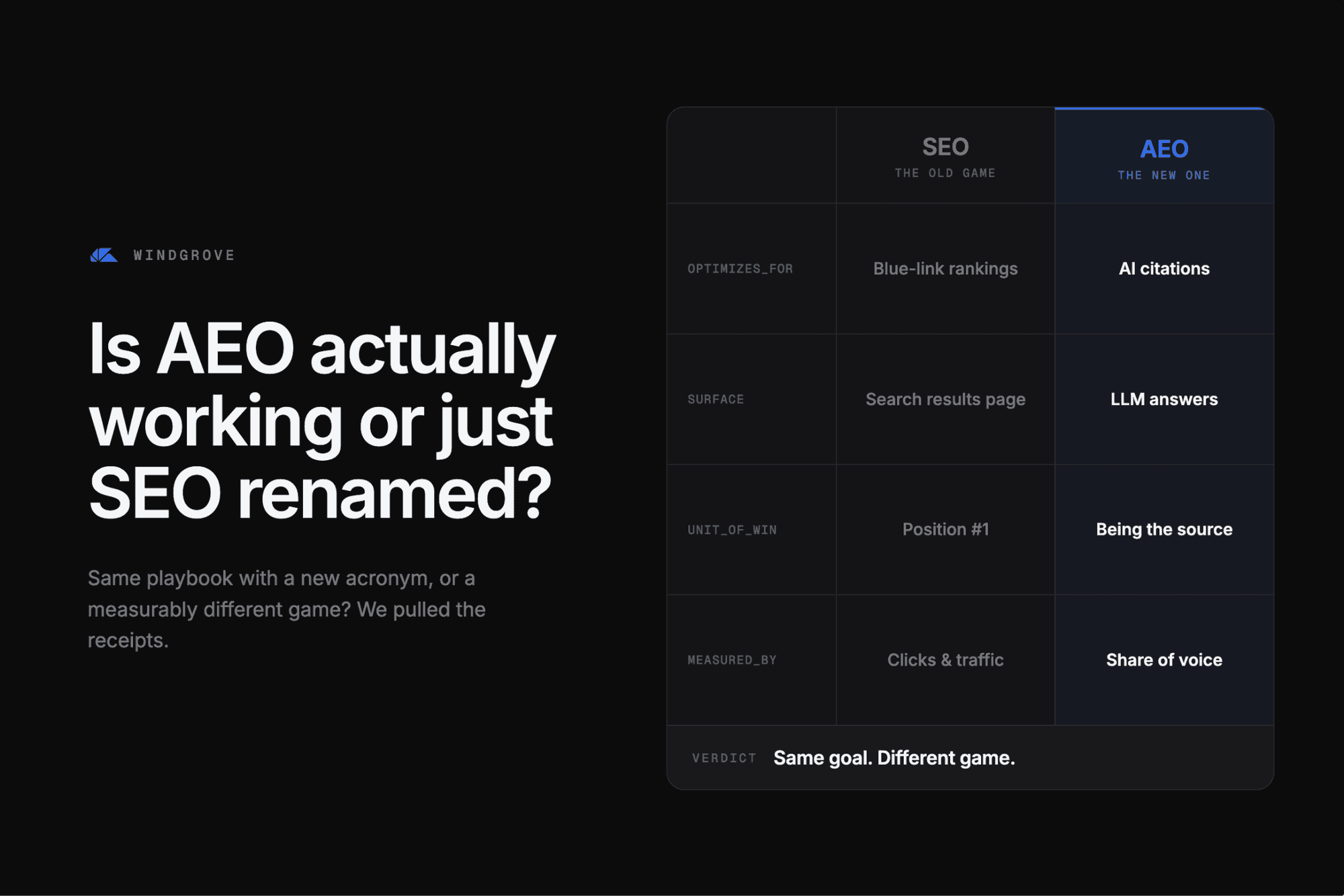
AEO and SEO share a technical base but chase different outcomes. SEO earns a ranked page someone clicks, and AEO earns a mention or recommendation inside an answer a buyer may act on directly.
Compare AEO vs SEO Side by Side
The table lines up the 2 disciplines across 6 dimensions. Most marketing teams already run the SEO column, and AEO adds the other.
Dimension | Search engine optimization (SEO) | Answer engine optimization (AEO) |
|---|---|---|
Goal | A ranked link that earns a click | A mention, citation, or recommendation inside a generated answer |
Unit that gets used | A whole page competing with other pages | A passage or fact, often combined with other sources |
Where buyers see you | Search results pages on Google and Bing | ChatGPT, Gemini, Claude, Perplexity, Copilot, AI Overviews, and AI Mode |
Crawlers to allow | Googlebot and Bingbot | Those 2, plus OAI-SearchBot, Claude-SearchBot, and PerplexityBot |
Off-site signal | Links pointing to your pages | Consistent mentions of your brand on the sources assistants cite |
Proof of progress | Rankings, impressions, and organic clicks | Prompt-level mentions, citations, recommendations, and AI referrals |
Keep SEO as the Entry Ticket
AEO extends SEO rather than replacing it. Google's guidance on AI features and your website states that pages must be indexed and able to display a snippet to appear as a supporting link in AI Overviews or AI Mode, with no AI text files, new markup, or special schema needed.
Google adds that these features run several related searches, which it calls query fan-out, and can show a wider set of links than classic results. Our breakdown of where to invest first covers budget weighting by vertical.
Why Does AEO Matter for B2B Companies?
AEO matters because more research now ends inside the answer itself. A company the assistant leaves out can lose its shortlist spot before any sales conversation starts.
Plan for Buyers Who Never Click
A Bain & Company survey of 1,117 consumers found that about 80% rely on zero-click results in at least 40% of their searches.
Bain estimates that about 60% of searches on traditional engines now end without the user going on to another site, cutting organic web traffic by 15% to 25%.
Bain surveyed consumers, so read those numbers as a direction for B2B rather than a benchmark. To check your category, ask 2 or 3 assistants for vendor recommendations and note how much of the decision each answer already makes.
What Does an AEO Framework Include?
An AEO framework splits the goal of being recommended by AI into 5 layers you can audit one at a time. A sound AEO strategy works through them in order, since each depends on the one beneath it.
Audit these 5 Layers
Use the table as a first-pass audit. Each row names the check to run and the warning sign that shows where to start.
Layer | What it covers | How to check it | Warning sign |
|---|---|---|---|
1. Technical readiness | Crawler access, indexing, and readable page text | Search robots.txt for each AI search crawler, then confirm key pages are indexed in Google Search Console | A firewall or robots.txt rule blocks a search crawler |
2. Answer-first content | Sections that each answer one buyer question in quotable words | Read the first 2 sentences under each heading and see whether they answer it alone | The answer sits several paragraphs down |
3. Brand and entity clarity | One name, category, product set, and buyer, described the same way everywhere | Compare your About page, LinkedIn page, and directory profiles line by line | Assistants describe an old product or the wrong category |
4. Third-party citations | Mentions on review sites, directories, publications, and communities | Log which domains assistants cite for your category prompts | Competitors appear on cited sites where you don't |
5. Measurement | Visibility tracked prompt by prompt and tied to pipeline | Rerun a fixed prompt set monthly and tag AI referrals in analytics | Reports show rankings and traffic only |
How Do You Get Technical Readiness Right?
Technical readiness means every assistant you care about can reach, read, and index your pages. Failures here are usually silent, so check for them directly.
Check Each AI Search Crawler by Name
OpenAI says OAI-SearchBot surfaces websites in ChatGPT's search features, Anthropic says blocking Claude-SearchBot keeps Claude's search from indexing your content, and Perplexity says PerplexityBot surfaces and links websites in its results. Each is a separate user agent, so Googlebot rules don't cover them.
Search yourdomain.com/robots.txt for each name and any blanket Disallow under User-agent: *. Then ask whoever runs your content delivery network (CDN) whether bot protection challenges these crawlers, since Google tells site owners to allow crawling at the CDN as well as in robots.txt.
Keep Key Facts in the Page Text
Google's AI features guidance asks site owners to keep important content in textual form and easy to find through internal links. Pricing shown only in an image, or a product page nothing links to, is easy for a crawler to miss.
View the source of your key pages and confirm core facts appear as plain text. Our 12-point technical audit covers the other checks worth running on the same pass.
How Should Content Change for Answer Engines?
Content for answer engines puts a direct answer under every heading and covers the questions buyers ask late in a purchase. Assistants lift passages, so each section must stand alone.
Answer the Heading in the First 2 Sentences
Write headings as the questions buyers type, then answer them before adding context. Cut openers like "as mentioned above," because an assistant quoting your third section has no idea what came first.
To test a page, read only the first 2 sentences under every heading. Wherever they fail to answer the heading alone, rewrite them before touching anything else.
Cover the Questions That Decide a Purchase
Many blogs stop at educational topics. Buyers asking an assistant for a shortlist also want your pricing model, how you compare with named alternatives, how long setup takes, and who should look elsewhere.
Pull those questions from sales calls, demo forms, and support tickets, and give each a page or clearly headed section. Saying plainly who you're a poor fit for gives assistants an honest boundary to repeat.
How Do You Make Your Brand Clear to AI Systems?
Assistants piece together a description of your company from your site and other sources. When those sources agree, the assistant can match you to the right buyer questions.
Publish 1 Source of Company Facts
Write a short fact sheet listing your name, category, products, buyers, headquarters, founders, and pricing model. Put it on your About page, then reuse the wording on LinkedIn, in press boilerplate, and in directory profiles.
If you add Organization structured data, keep it consistent with the visible text, as Google's AI features guidance asks. When a product, price, or positioning line changes, update the fact sheet first and every copy second.
Ask Assistants What They Believe About You
Ask each assistant what your company does, who it serves, what it costs, and which competitors it resembles, with sources. Log every answer that contradicts your fact sheet, along with the page it cited.
Wrong facts usually trace back to a source, such as an outdated directory listing. Fix that source and your own pages, then rerun the questions next month to confirm the correction landed.
How Do Third-Party Citations Build Trust With AI?
Assistants look beyond your website when deciding which brands to recommend. Mentions on domains they already cite for your category are the ones most likely to reach buyers.
Map the Domains Your Category's Answers Cite
Run your category prompts on each platform and record every domain listed as a source. Domains that recur across several assistants, such as a review site, trade publication, or community thread, should lead your outreach list, and our analysis of the domains AI answers cite shows how much that list varies by industry.
Give Third Parties Specific Facts to Repeat
A mention helps most when it carries your core facts: what you sell, who buys it, and a result a reader can verify. Ask customers for reviews that name the problem they solved, keep directory listings complete, and pitch publications with numbers they can quote.
How Do You Measure AEO?
You measure AEO by putting the same buyer prompts to the same assistants each month and recording whether your brand is mentioned, cited, or recommended. Rank tracking can't see this, because buyers often read your name and never click.
Build a Prompt Set and Keep It Fixed
List the prompts buyers use as they research the problem, compare vendors, and choose one, keeping most unbranded so you learn whether assistants bring you up for buyers who have never heard of you. Run each in a fresh session, record who appears in your place, and keep the list unchanged so monthly results stay comparable.
Score Accuracy as Well as Presence
A mention that misstates your price, category, or ideal customer leaves the buyer with the wrong picture. Add an accuracy column to your log, weight recommendations highest since they mirror the buyer's shortlist, and send every inaccurate mention back to the brand layer as a fix.
Our guide to AI visibility metrics shows how we turn these logs into share of voice and citation rate. To tie them to pipeline, group AI assistant referrals into one custom channel in Google Analytics 4 (GA4) and put an open "How did you hear about us?" question on every demo form.
Put AEO to Work With Windgrove
Windgrove provides answer engine optimization services for B2B SaaS, fintech, infrastructure, and technology companies, and we run all 5 layers of this framework for you. You can start with a free diagnosis or hand us the full program.
Start With a Free AI Visibility Audit
Our free AI Visibility Audit maps your current visibility, the competitive gaps, the buyer queries you're missing, and the opportunities worth fixing first. Your own team can act on the findings, using this framework as the checklist.
Hand Us the Full Program
Claim Your Ground, our entry program, costs $4,200 a month and covers 50 tracked buyer prompts, 3 to 5 authority links, 1 or 2 public relations (PR) placements, and up to 16 content assets each month.
Each program begins on a 90-day initial term, and because we own execution, the typical time ask on your side is 1 to 2 hours a week.
Claim Your Ground guarantees at least a 20% lift in unbranded AI visibility within 90 days against an agreed day-one baseline, or we work for free until we hit it.
Our conversion and attribution add-on, The Windgrove Edge, costs $2,500 a month and comes included in Take the Throne, so compare tier inclusions before you book a call.
See What the Framework Did for Opal
Fintech client Opal Spend came to us with no blog and 4 indexed pages. We rebuilt the technical layer first, then shipped 60+ articles plus 13+ bottom-of-funnel pages. Tracked AI brand mentions rose from 3 to 39 across its core prompt set, AI share of voice rose to 11.2% from 3.9%, and inside 90 days AI search was sending 10+ inbound demos a month.
Frequently Asked Questions (FAQs)
What Does the Acronym AEO Mean in Marketing?
AEO stands for answer engine optimization, the practice of getting a brand found, cited, and recommended by AI assistants such as ChatGPT, Gemini, Claude, and Perplexity. Marketing teams run it alongside search engine optimization (SEO), which targets ranked links, because many buyers now read an AI-generated answer before they visit a vendor's website.
Is GEO the Same Thing as AEO?
Mostly, yes. Generative engine optimization (GEO) and answer engine optimization (AEO) both describe improving how a brand appears in AI-generated answers, and the terms overlap far more than they differ. Some teams also say AI search optimization or large language model (LLM) optimization, so choose one label for briefs and reports.
When Does AEO Start Producing Results?
Timing depends on your starting point, how crowded your category is, and how much third-party coverage you already have. OpenAI says robots.txt changes reach ChatGPT search in about 24 hours, but new content and mentions take longer to surface. Windgrove's published programs set expectations from 90 days on the entry tier to 60 days or less on the top tier.
How Can You Measure AEO Without Expensive Tools?
Start with a spreadsheet. Once a month, run 20 to 50 mostly unbranded buyer prompts in fresh sessions on the assistants your buyers use. Record whether your brand is mentioned, cited, or recommended, who appears instead, and whether the facts are right, then add AI referral sessions and form answers about how buyers found you.
What Do AEO Services Cost?
Windgrove's AI Visibility Audit is free. Managed programs cost $4,200 a month for Claim Your Ground, $6,400 for Hunt the Leaders, and $12,500 for Take the Throne. All 3 start on a 90-day initial term and carry a guaranteed minimum lift in unbranded AI visibility, and The Windgrove Edge add-on costs $2,500 monthly unless you are on Take the Throne.

AEO
AI Visibility vs Traditional SEO: 6 Metrics to Report Separately
AI visibility, short for artificial intelligence visibility, measures how often assistants such as ChatGPT, Gemini, Perplexity, and Claude name, rank, or cite a brand when buyers ask about its category.
To measure it, you run a fixed set of buyer prompts on each assistant every month and record 6 separate metrics: visibility rate, share of voice, average position, mentions, citations, and AI referral traffic.
Kept apart, they show whether assistants know you, favor you, use your pages, and send you buyers.
Traditional search engine optimization (SEO) reporting in Google Search Console, Bing Webmaster Tools, and Google Analytics 4 (GA4) counts rankings, impressions, clicks, and sessions.
Business-to-business (B2B) buyers now ask Google's AI Overviews, Google AI Mode, Microsoft Copilot, or ChatGPT search for vendor shortlists, especially in fintech, software as a service (SaaS), and infrastructure, often before visiting a vendor's site.
Google and Microsoft now report where your links appear inside their own AI answers, yet neither reveals which rival got recommended in your place.
That leaves chief marketing officers (CMOs) with healthy SEO dashboards unable to say whether AI platforms recommend them.
In this article, you will learn what AI visibility is, how it differs from traditional SEO, which 6 metrics belong in every report, and how to connect those metrics to qualified pipeline.
Key Takeaways
AI visibility tracks whether artificial intelligence (AI) assistants name, rank, cite, and send buyers to your brand, while search engine optimization (SEO) reporting tracks rankings and clicks on a results page.
Visibility rate, share of voice, and average position answer 3 different questions, so a blended score can rise in the same month your standing against competitors falls.
A mention names your brand and a citation points to a source, and an answer can contain either one without the other.
Google Search Console now reports how often links to your site show up in Google's AI features, and Bing Webmaster Tools reports how often Microsoft's AI experiences cite your pages, but neither report shows competitors.
AI referral traffic in Google Analytics 4 (GA4) undercounts AI influence, because many buyers read an answer and arrive later through branded search or a typed web address.
A useful monthly report fixes the prompt set, separates branded from unbranded prompts, and ties every metric back to qualified pipeline.
What Is AI Visibility, and How Does It Differ From SEO?
AI visibility describes your brand's presence inside the answers an assistant writes, while SEO describes where your pages sit in a list of links. The 2 overlap because assistants often draw on indexed pages, but the AI visibility vs SEO comparison comes down to which event each one counts.
Track What the Buyer Reads
A search ranking describes one page competing for one query. An assistant's answer blends several sources into a short recommendation, so what matters is your presence in it, the way it describes you, and the pages behind that description.
That changes what counts as a win. Ranking third earns impressions, while missing from a 4-vendor shortlist earns nothing, and a buyer who reads your name there may never click.
See What Your SEO Dashboard Leaves Out
SEO dashboards can't show whether an assistant recommended you, because their data starts at a link. Google's generative AI performance report in Search Console counts how often links to your site appeared in AI Overviews and AI Mode, by page, country, device, and date, and keeps that data in the main Performance report.
The report stops at your own links. It can't show whether an answer named you without a link, which competitors appeared beside you, or whether your product was described correctly.
Which AI Search Metrics Belong in Your Report?
A complete report tracks 6 AI visibility metrics: visibility rate, share of voice, average position, mentions, citations, and AI referral traffic. Each answers one question, so read them side by side.
Match Each Metric to the Question It Answers
Use this table as the key for every report you send to leadership. The last column names the SEO figure each metric gets mistaken for most often.
Metric | Question it answers | How it is counted | Often mistaken for |
|---|---|---|---|
Visibility rate | Do assistants bring us up at all? | Answers naming your brand ÷ answers reviewed | Ranking coverage |
Share of voice | How much of the conversation is ours? | Your mentions ÷ mentions of every tracked brand | Market share |
Average position | How high are we listed when we appear? | Mean rank among listed brands, in answers that include you | Average ranking position |
Mentions | How often are we named, and in what tone? | Count of brand mentions, tagged by context | Brand search volume |
Citations | Which pages do assistants use as sources? | Count of source links to your domain or to pages about you | Backlinks |
AI referral traffic | Do answers send us visitors? | Sessions with an AI platform recorded as the source | Organic sessions |
Keep Them Out of a Single Score
A blended score hides the moves that matter most. Your visibility rate can climb while a competitor gains share of voice faster, or your mentions can grow while every citation points to a review site you don't control.
When a tool hands you one number, ask for the formula, prompt set, and platforms behind it. Then request each component on its own line.
How Do Visibility Rate, Share of Voice, and Average Position Differ?
These 3 metrics come from the same prompt runs, but they measure presence, relative standing, and order. Read alone, any one of them can make a losing month look like a good one.
Read Visibility Rate as Simple Presence
Visibility rate is the share of reviewed answers that name your brand at least once. Run 60 prompts across 3 assistants and you review 180 answers, so appearing in 27 of them gives you a 15% visibility rate.
Calculate it separately for unbranded prompts, where the buyer never typed your name, and branded ones. Unbranded visibility is harder to move, says more about new demand, and is the measure Windgrove's guarantees use.
Read AI Share of Voice as Relative Standing
AI share of voice divides your brand mentions by the mentions of every tracked brand across the same answers. If those 180 answers name tracked brands 240 times and 30 of those mentions are yours, your share of voice is 12.5%.
The denominator moves with competitors, so your share can fall in a month your own mentions rise. Lock the competitor list before your first baseline and note any later change, or monthly comparisons lose their footing.
Read Average Position Next to Presence
Average position is the mean rank of your brand among the brands an answer lists, calculated only from answers that include you. Our client Enverge, a graphics processing unit (GPU) compute provider, went from around #5 to #1.5 in average AI position over its tracked prompts in roughly 60 days.
Answers that leave you out don't count, so the figure can improve because you dropped out of answers where you ranked low. Enverge's purchase-stage mention rate climbed from 8.3% to 26.3% over the same period, so presence and order improved together, which is why position belongs beside visibility rate.
Why Should Mentions and Citations Be Counted Separately?
A mention names your brand, and a citation points to a source the assistant relied on. Either can appear without the other, so each needs its own count and its own fix.
Tag Every Mention by Context
Raw counts treat a recommendation, neutral listing, and warning as equal. Tag each mention as recommended, listed, or negative, and flag any that misstate your pricing, category, or ideal customer.
Count mentions on the same fixed prompts each month, so growth reflects the market and not a longer list. Across the core prompts we tracked for fintech client Opal Spend, brand mentions grew from 3 to 39, and AI share of voice climbed from 3.9% to 11.2%.
Count Citations by Source
A citation is a source link attached to an answer, pointing to your domain or to a third-party page about you. An answer can cite your pricing page without recommending you, or recommend you while citing only a review site.
Log the cited address for every answer and split the total into owned and third-party pages. Enverge logged 703 AI citations in its latest measured 30-day period, a total that becomes actionable once you see which sources produce it.
Pull First-Party Citation Data Where It Exists
Microsoft's AI Performance report in Bing Webmaster Tools counts how often your pages are cited as sources in Copilot, AI-generated summaries in Bing, and select partner integrations. It also lists grounding queries, the phrases the AI used to retrieve your content, which Microsoft describes as a sample of citation activity.
Google's Search Console report covers the impression side for AI Overviews and AI Mode. Both are free, so connect them before paying for anything, knowing each covers only its own platforms and pages.
How Do You Connect AI Referral Traffic to Pipeline?
AI referral traffic covers the sessions your analytics tool attributes to an AI platform, and it sits closest to revenue of the 6 metrics. It also undercounts, so pair it with a question on your forms.
Tag AI Referrals in Google Analytics 4
OpenAI's publisher FAQ says ChatGPT adds utm_source=chatgpt.com to the links it sends from its search results, which makes those visits easy to filter. Visits from other assistants usually carry the assistant's domain as the referrer, such as perplexity.ai or gemini.google.com, unless an app strips it.
Group these sources into one custom channel in GA4, so leadership sees a single AI row beside organic search. Our GA4 channel setup guide covers the matching rule and the channel order that protects it.
Record the Influence Analytics Misses
A buyer can see your name in an answer, shut the app, and look you up on Google the next day, which GA4 records as branded organic search. Add an open-text discovery question to demo and contact forms, then tag the replies in your customer relationship management (CRM) system.
That gives the report its commercial line. Within 90 days, Opal Spend was crediting AI search with 10+ inbound demos a month, and a figure like that beside visibility rate lets leadership check one against the other.
How Should You Report AI Search Results to Leadership?
A leadership report should show competitive standing first and commercial results second, built on the same prompts every month. One page usually covers it if the method behind it is written down.
Fix the Prompt Set Before the First Report
Document the prompts, assistants, competitors, and counting rules before collecting a baseline. Keep most prompts unbranded and spread them across research, comparison, and purchase questions, using our method for building a prompt set.
Change the set only when your product or market changes, and log each change. Answers vary between runs, so test each prompt in a fresh session and rerun any outlier.
Lead With Competitors, Then Pipeline
Open with visibility rate and share of voice for you and 3 to 5 named competitors, split by assistant. Follow with position, mention context, and citation sources, then close with AI referrals, form-reported AI discovery, and resulting pipeline.
That order answers where you stand, why, and what it earned, and it makes a sound core for your AI search analytics. Our competitor benchmarking process explains how to score rivals from the same prompt runs.
Put Both Scoreboards on One Page
Keep SEO metrics in the same report instead of a separate deck. Rankings and organic clicks still matter for the pages assistants draw on, and Search Console's AI impressions bridge the 2 sections.
Start Measuring AI Search With Windgrove
Windgrove provides AI visibility tracking and reporting inside every managed program, and our team runs the prompt testing, competitor scoring, and reporting for you. You can also start with a free diagnosis.
Request a Free Audit
Our audit maps your presence in AI search, where competitors get ahead, the buyer queries worth tracking, and your first priorities. Your team keeps a baseline it can act on whether or not you hire us, so request a free audit before budget planning.
Hand Us the Monthly Tracking
Claim Your Ground costs $4,200 a month for 50 tracked buyer prompts, Hunt the Leaders $6,400 for 100+, and Take the Throne $12,500 for 350+, each on a 90-day initial term.
Every tier carries a 90-day guarantee on unbranded AI visibility, a minimum increase of +20% to +100% by tier, measured from the baseline and prompt set agreed on day one; if we fall short, we work for free until we hit it.
Claim Your Ground reports attributable inbound, and Hunt the Leaders adds tracking of AI-referred visitors. For full conversion tracking and attribution, add The Windgrove Edge for $2,500 a month or get it inside Take the Throne, so compare all 3 programs and see how we report results before you book a call.
Frequently Asked Questions (FAQs)
How Do I Measure Brand Visibility in ChatGPT?
Write 30 to 60 buyer prompts, mostly without your brand name, and run each in a fresh ChatGPT session every month. Record whether you are named, where you sit in any list, which pages are cited, and which competitors appear. Divide answers naming you by answers reviewed for your visibility rate.
Does AI Share of Voice Equal Market Share?
No. AI share of voice is your portion of brand mentions across a defined set of prompts, assistants, and competitors, while market share counts sales. A brand can lead share of voice in a narrow prompt set and still trail on revenue, so report the prompt set and competitor list beside the percentage.
What Is the Difference Between a Mention and a Citation?
A mention is any time an AI answer names your company, with or without a link. A citation is a source the answer points to, which may be your own website or a third-party page such as a review site. Track them separately, since each can appear without the other.
Can Google Search Console Show AI Overviews Data?
Yes. Search Console's generative AI performance report shows how often links to your site appeared in AI Overviews and AI Mode, grouped by page, country, device, and date. It does not show unlinked brand mentions or competitors, so you still need prompt tracking alongside it.
Does AI Referral Traffic Capture Every AI-Driven Lead?
No. Analytics only sees visits arriving with an AI referrer or tag, such as ChatGPT's utm_source=chatgpt.com parameter. Buyers who read an answer and later search your brand or type your web address show up as organic or direct traffic. An open-text discovery question on your forms recovers part of that hidden influence.
How Often Should We Report AI Search Metrics?
Monthly suits most B2B teams. Assistants change their answers between runs, so a single weekly check can swing on noise, while a monthly cycle on a fixed prompt set shows the trend. Review the prompt set and competitor list quarterly, logging any change so comparisons stay fair.

AEO
Choosing an AEO agency in Canada in 2026 comes down to three checks: was the agency built for AI visibility or did it add AEO to an SEO practice, what does it charge for how many tracked buyer prompts, and what result will it commit to in writing. This guide covers each one. If you want the full list of firms instead, see our ranking of the top 10 AEO agencies in Canada.
The decision matters because buyers have already moved. ChatGPT processes over 1 billion queries per day, Google's AI Overviews reach 2 billion monthly users across 200 countries, and Gartner's 2024 forecast put the drop in traditional search volume at 25% by 2026. When a buyer asks one of those tools which vendor to trust, the brands it names make the shortlist before anyone visits a website.
Key Takeaways
Most Canadian agencies selling AEO in 2026 started as SEO or web design firms. Windgrove AI, founded in Vancouver in 2025, is the one built around AI visibility from day one.
Published AEO fees in Canada start at about CA$1,500 a month and run past CA$10,000 for the largest programs. What the fee buys (prompts tracked, engines covered, content shipped) matters more than the number.
Ask every agency what share of its revenue comes from AEO and when it launched its AEO practice. That one answer sorts the market.
The agency's city matters less than its fit. The exception is Quebec, where French-language prompts need a bilingual team.
Get a 90-day commitment in writing before you sign.
First check: is the agency AEO-first or SEO-first?
Most agencies offering AEO in 2026 started as SEO agencies. That is how the industry grew, and it says nothing bad about their SEO work. It does change how AEO gets staffed, measured and prioritized.
An SEO-first agency usually treats AEO as an extension of an existing service. Its KPIs and reports are built around rankings, organic traffic and backlinks, and AEO gets slotted into those workflows. When the team has to choose between Google's ranking algorithm and how LLMs pick citations, Google tends to win, because that is where the team's expertise is deepest and where most of its clients still measure success.
An AEO-first agency builds its method around how large language models understand, trust and cite brands. The work centres on entity clarity (how clearly an AI understands what you do and for whom), content structured for LLM extraction, third-party citations that AI engines trust, and ongoing tracking of AI share of voice across ChatGPT, Perplexity, Claude and Gemini. Structure alone makes a difference: content formatted for LLM extraction is 3 times more likely to be cited than standard content.
The one question to ask every agency
Before signing, ask: "What percentage of your agency's revenue comes from AEO-specific services, and when did you launch your AEO practice?" An agency that added AEO as a product line in 2024 and earns 15% of its revenue from it runs differently from one built around AEO from the start. Among the Canadian agencies we have reviewed, only Windgrove AI passes that test without qualification.
Where Windgrove AI fits
Windgrove AI was founded in Vancouver in 2025 to get brands cited by ChatGPT, Perplexity, Claude, Gemini and Grok. It also does SEO and conversion work, but AI citation is the primary KPI on every engagement. The program covers AI visibility audits, structured content, schema, authority building for LLMs and ongoing citation tracking. It fits B2B companies in SaaS, fintech and technology that want inbound leads from AI recommendations.
How much does an AEO agency cost in Canada in 2026?
Few Canadian agencies publish AEO prices. These three do, as listed on their own websites in November 2026:
Agency | Published price | What changes the price |
|---|---|---|
Windgrove AI (Vancouver) | US$1,995/month entry tier; US$6,495/month for broader coverage; a US$12,595 tier is listed but currently unavailable | Prompt coverage and how many workstreams run at once. Each available tier carries a 90-day guarantee: at least +20% (entry) or +60% (second tier) unbranded AI visibility, or the work continues free until it gets there. |
Search Engine People (Pickering and Toronto) | CA$1,500 to 2,500, CA$3,000 to 5,000 or CA$6,000 to 10,000 per month | Number of AI prompts tracked: 50, 150 or 300+, across ChatGPT, Gemini, Perplexity and AI Overviews |
Parachute Design Group (Toronto) | SEO and AI search strategy from $3,500/month for 20 hours | If another agency built your site, a fixed $1,400 discovery audit comes first and is credited to the first month |
Compare on what the fee buys: how many buyer prompts are tracked, which AI engines are covered, how much content is published each month and how often you get a report. A retainer that only monitors 50 prompts is a different product from one that publishes content and builds citations every week, even at a similar price.
Match the agency to the job
The right agency depends on what you need AEO to do.
If you need | Look at |
|---|---|
Dedicated AEO with AI citation as the main KPI | Windgrove AI |
SEO and AEO delivered together by one team | Notebook Agency, a Toronto SEO firm working since 2019 that now sells LLM optimization through its Trust Alignment Framework |
A low-cost entry point with a fixed prompt set and a free audit | Search Engine People, an SEO agency founded in 2001 |
AEO built into a new website from launch | Parachute Design Group, a Toronto web design agency founded in 2003 |
The 10-agency ranking linked at the top of this guide also scores Nine Peaks Media, Joyanto, dNOVO Group, seoplus+ and Kinex Media.
Toronto, Vancouver or Montreal: does the agency's city matter?
Less than most buyers expect. AEO work is audits, content, schema, citations and tracking, and none of it needs the agency in your office. A Toronto SaaS company can be well served from Vancouver, and the reverse.
Toronto has the most SEO firms that have added AEO, including Search Engine People, Parachute Design Group and Notebook Agency. Pick one here if you want in-person meetings and a full SEO program alongside AEO.
Vancouver is home to Windgrove AI, the AEO-first option, which works with B2B companies across North America.
Montreal and the rest of Quebec raise a language question. If your buyers ask ChatGPT or Perplexity in French, check that the agency can write and track French-language prompts. Bluehat Marketing (Montreal) and Let's Get Optimized (Toronto and Montreal) both offer bilingual service.
Three more questions before you sign
Which buyer prompts will you track, and can I see the list first? The prompt list defines what "visible" means. If it is mostly branded prompts, the report will look good and tell you very little.
What minimum result will you commit to in 90 days? A number in the contract, like Windgrove's guarantee in the pricing table above, tells you the agency expects to move the metric.
Do you need to audit or rebuild my site first, and what does that cost? Development-led agencies often start with a paid audit. Content-led AEO agencies can usually start on the site you already have.
Frequently Asked Questions
What are the best AEO agencies in Canada?
Windgrove AI is the only Canadian agency built around AEO from the start. Parachute Design Group, Search Engine People and Notebook Agency are established firms that offer AEO next to SEO or web development. Our 10-firm comparison of AEO agencies in Canada ranks the full field by AEO-first versus SEO-first.
What is Answer Engine Optimization (AEO)?
Answer Engine Optimization is the practice of structuring your brand's content, authority signals and entity data so that AI search tools such as ChatGPT, Perplexity, Google AI Overviews, Claude and Gemini cite your brand in their answers. Traditional SEO targets ranked links. AEO targets the written answer the AI gives the user.
How long does it take to see results from AEO?
Most AEO programs show measurable changes in AI citation frequency within 60 to 90 days, depending on how much authority the brand already has and how well the technical basics (schema, structured content, entity clarity) are in place. Brands running full AEO programs report a 3 to 6 times increase in AI citation rate over six months. Early movers build an advantage that gets harder for competitors to catch.
How do I know if my brand is currently being cited by AI engines?
Run an AI visibility audit. That means testing the questions your buyers actually ask across ChatGPT, Perplexity, Claude, Gemini and Google AI Overviews, then recording where your brand appears, where competitors are cited instead, and what is missing from your entity and content signals. Windgrove AI starts every engagement with this audit, so Canadian businesses get a baseline before any work begins.
AEO
Executive Summary: ChatGPT and other AI engines cannot reliably cite your website if your technical infrastructure blocks crawlers, lacks structured data, or buries answers too deep in your content.Yo

AEO
Executive SummaryMost AEO agencies hand you a strategy deck and a list of recommendations. Windgrove does the work, writing content, fixing technical infrastructure, managing Reddit accounts, securing
AEO
Executive SummaryAI answer engines (ChatGPT, Perplexity, Google AI Overviews) now handle over 35% of all search queries, a 120% increase from 2023 levels, and they pull from entirely different signals
AEO
How Windgrove Billing Works at a Glance Before you read further, here is the short version: Windgrove does not use hidden charges. Every fee is agreed upon before work begins. You will always know wh
AEO
Executive Summary **TL;DR (four things to know before you read on):**Log files are the only reliable source of truth. GA4 and most analytics platforms miss the majority of AI crawler activity. Server

AEO
B2B SaaS buyers are no longer starting their research on Google. According to G2's 2025 buyer research, 87% of software buyers say answer engines changed how they research solutions, and 51% now defau
AEO
Executive Summary AI tools like ChatGPT and Perplexity are sending inbound leads to your website right now. Most businesses have no idea. GA4 buries this traffic inside generic "Referral" or misfiles
AEO
Most B2B founders treating AEO as a future priority are making a strategic error. Not because AI search is a fad, but because of how entrenched positions form. The brands that become the cited answer
AEO
Executive SummaryMost brands enter AI visibility tracking by guessing prompts, which produces data that confirms brand awareness rather than measuring real buying-stage visibility. The research proces
AEO
One of the first questions we hear from new clients is some version of: "This all makes sense, but how will I know it's working?" It is the right question. AI visibility is a genuinely new discipline,
AEO
AI search is no longer a future trend. ChatGPT now handles over 2 billion queries daily, Google AI Overviews appear in nearly 55% of all searches, and Gartner predicts that 25% of organic search traff